Temple Street, London, E2

- PROPERTY TYPE
Terraced
- BEDROOMS
2
- BATHROOMS
2
- SIZE
1,053 sq ft
98 sq m
Key features
- Design-Led
- Rear Courtyard
- Historic Artisanal Workshop
- Original Victorian Features & Frontage
- Double Height Spaces
- Two Bedrooms, Two Bathrooms
Description
Summary -
Forming part of the distinctive late Victorian Winkley Estate, built between 1898 and 1904, the street belongs to a neighbourhood conceived not merely as housing, but as a self-contained working community: homes, workshops, factories and shops arranged in close, purposeful proximity by brothers Charles and Henry Winkley. It is a fragment of London's industrial past that survives with unusual completeness, now recognised as the core of the Old Bethnal Green Road Conservation Area.
The red brick terrace with workshop frontage is characteristic of the estate's residential typology. Unlike the more scattered survivals elsewhere in Tower Hamlets, the Winkley Estate retains its original grain almost entirely intact, offering a rare legibility of how late Victorian east London was actually built and inhabited.
This is not a building that has been preserved in amber. The surrounding neighbourhood has evolved into one of London's most culturally significant quarters, with the estate's former workshops now occupied by artists, ceramicists and designers. The architecture has proved remarkably adaptable, its generous volumes and honest construction absorbing contemporary life without losing the character that makes it exceptional.
The History -
The story of Temple Street is inseparable from the wider history of east London's furniture trade, an industry that once made Bethnal Green and Shoreditch the manufacturing centre of an entire nation's domestic life.
By the mid-nineteenth century, the area west of Cambridge Heath Road had become something approaching one enormous factory. Small workshops, timber yards and polishing rooms lined every street and alley, their output flowing to the great retail houses of Tottenham Court Road and beyond. Cabinet makers, upholsterers and French polishers worked in a dense network of interdependent trades, with raw timber arriving via the Regent's Canal and finished pieces dispatched by horse-drawn cart to wholesalers across the city.
It was into this thriving ecosystem that brothers Charles and Henry Winkley intervened at the close of the century. Between 1898 and 1904, they demolished four blocks of older terraced housing between Temple Street and Teesdale Street and replaced them with a planned mixed-use development that integrated three types of residential accommodation with three small factories, numerous cabinet makers' workshops, and a row of shops along Old Bethnal Green Road.
The four blocks were designed as a community in miniature. High-fronted shops occupied the commercial streets, while behind them, mews courtyards concealed rows of one and two-storey workshops, each with its own loading doors for handling timber and large items of furniture. The three-storey terraces facing Temple Street and Teesdale Street combined ground floor workshops with residential accommodation above, enabling craftsmen to live directly beside their place of work.
This integration of domestic and productive space was not unusual in east London, but the completeness and coherence of the Winkley Estate was exceptional. It represented the high point of a building tradition rooted in the realities of artisan life, where the boundaries between home and workshop were deliberately fluid. The estate contained the largest number of surviving purpose-built furniture workshops in Tower Hamlets and became, in time, a nationally important record of the renowned East End furniture trade.
The trade itself declined through the twentieth century, its slow collapse accelerated by wartime bomb damage, the rise of out-of-town manufacturing, and shifting economic currents. By the 1980s, the furniture industry had all but disappeared from these streets. Yet the buildings remained, and with them the spatial logic of the original plan. In 2008, the Old Bethnal Green Road Conservation Area was designated, with the Winkley Estate at its centre, formally recognising the architectural and historic significance of what Charles and Henry Winkley had created over a century earlier.
How it Feels Upstairs -
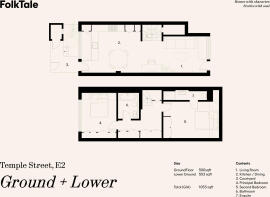
Arranged across the ground floor and lower ground floor, the apartment inhabits the old workshop space itself, entered through the original workshop entrance from Temple Street. Where cabinet makers and French polishers once handled timber and upholstery, the building now accommodates a considered two-bedroom home whose proportions and character are entirely a product of its industrial past.
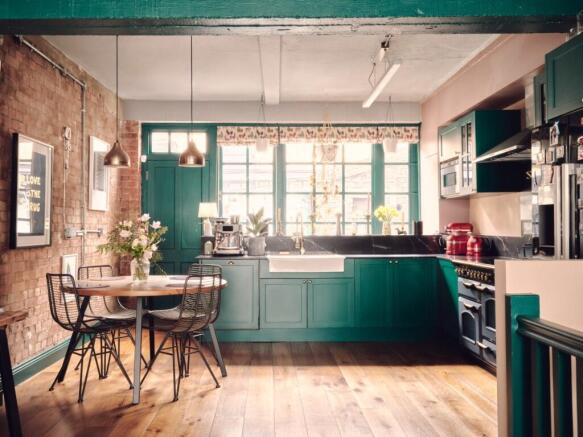
The upper level, at ground floor, is given over to living. The kitchen and reception space benefit from the generous volumes and robust construction typical of the estate's workshop terraces, where ceiling heights and wide openings were determined by the practical demands of furniture making rather than domestic convention. Light enters from both the street-facing elevation and the rear, filtered through the distinctive fenestration of the original workshop windows, lending the space an atmosphere quite distinct from a conventional residential interior.
How it Feels Downstairs -
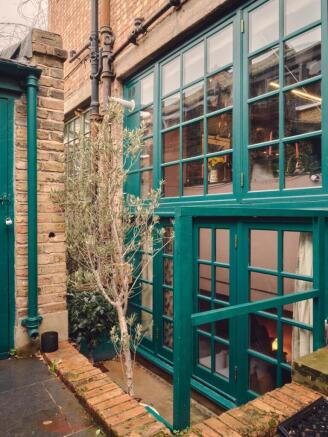
Below, at lower ground level, the two bedrooms occupy what was historically the well-lit semi-basement workspace. Lightwells to the front and rear draw daylight down into both bedrooms, preserving the quality of natural illumination that was originally designed to serve the demands of detailed handwork. Glimpses of brick and planting through the lightwell glass connect the rooms to the courtyard outside without compromising their seclusion. There is a privacy and a containment to this level that makes it naturally suited to sleeping accommodation, a quiet counterpoint to the more open, sociable character of the floor above.
To the rear, the courtyard offers a generously sized outdoor space.
The vertical arrangement of the home, living above, sleeping below, inverts the more common London pattern and in doing so echoes something of the building's original logic, where the ground floor workshop was the public, active space and the floors below offered a more enclosed, focused atmosphere. It is a home shaped not by a developer's floor plan but by the accumulated intelligence of the building itself: its structure, its history, and the particular way it meets the street.
The Local Area of Bethnal Green & Transport -
Bethnal Green has gradually evolved into one of east London's most culturally concentrated neighbourhoods. Temple Street sits at the intersection of several distinct but overlapping communities, where longstanding local institutions coexist with a newer generation of restaurants, galleries and independent businesses.
The immediate surroundings include Common E2, a neighbourhood coffee shop of genuine quality on Old Bethnal Green Road, and The Marksman on Hackney Road, a Michelin-starred public house that remains rooted in its local context. Nearby, The Approach Tavern continues to serve as both pub and gallery, while Brawn on Columbia Road offers a seasonal, ingredient-led menu that has made it one of east London's most respected restaurants. The area's culinary range extends from E Pellicci, a Grade II listed Italian cafe that has served the neighbourhood since 1900, to the celebrated Tayyabs on Fieldgate Street.
The gallery scene is equally rich with a variety of exhibition spaces within walking distance, alongside a broader constellation of artist-run projects and design studios. The Winkley Estate's own Crown Works Pottery, housed in the original workshop yards, is home to ceramicists and makers who have found in these buildings exactly the kind of productive, characterful workspace that the Winkleys originally intended.
Columbia Road Flower Market and Broadway Market are both within easy reach on foot, as is Brick Lane and the wider Shoreditch district. Green space is well served: Haggerston Park lies to the north, while the Regent's Canal towpath provides a continuous walking and cycling route through to Victoria Park in the east and King's Cross to the west. Closer still, Middleton Green is a single block away.
Transport connections are strong. Bethnal Green Underground Station (Central Line) and Cambridge Heath Overground Station are both approximately equidistant, each within a five-minute walk. Numerous bus routes along Hackney Road and Bethnal Green Road provide further connections to the City, Shoreditch and the West End. For those travelling by bicycle, the City is reachable in under ten minutes. It is a location defined by proximity: to culture, green space, and the rest of London.
- COUNCIL TAXA payment made to your local authority in order to pay for local services like schools, libraries, and refuse collection. The amount you pay depends on the value of the property.Read more about council Tax in our glossary page.
- Ask agent
- PARKINGDetails of how and where vehicles can be parked, and any associated costs.Read more about parking in our glossary page.
- Ask agent
- GARDENA property has access to an outdoor space, which could be private or shared.
- Back garden
- ACCESSIBILITYHow a property has been adapted to meet the needs of vulnerable or disabled individuals.Read more about accessibility in our glossary page.
- Ground floor

Add an important place to see how long it'd take to get there from our property listings.
__mins driving to your place
Affordability


Notes
Staying secure when looking for property
Ensure you're up to date with our latest advice on how to avoid fraud or scams when looking for property online.
Visit our security centre to find out moreDisclaimer - Property reference TempleStreet. The information displayed about this property comprises a property advertisement. Rightmove.co.uk makes no warranty as to the accuracy or completeness of the advertisement or any linked or associated information, and Rightmove has no control over the content. This property advertisement does not constitute property particulars. The information is provided and maintained by FolkTale, London. Please contact the selling agent or developer directly to obtain any information which may be available under the terms of The Energy Performance of Buildings (Certificates and Inspections) (England and Wales) Regulations 2007 or the Home Report if in relation to a residential property in Scotland.
*This is the average speed from the provider with the fastest broadband package available at this postcode. The average speed displayed is based on the download speeds of at least 50% of customers at peak time (8pm to 10pm). Fibre/cable services at the postcode are subject to availability and may differ between properties within a postcode. Speeds can be affected by a range of technical and environmental factors. The speed at the property may be lower than that listed above. You can check the estimated speed and confirm availability to a property prior to purchasing on the broadband provider's website. Providers may increase charges. The information is provided and maintained by Decision Technologies Limited. **This is indicative only and based on a 2-person household with multiple devices and simultaneous usage. Broadband performance is affected by multiple factors including number of occupants and devices, simultaneous usage, router range etc. For more information speak to your broadband provider.