Tosside, Skipton, BD23

- PROPERTY TYPE
Detached
- BEDROOMS
8
- BATHROOMS
7
- SIZE
6,280 sq ft
583 sq m
- TENUREDescribes how you own a property. There are different types of tenure - freehold, leasehold, and commonhold.Read more about tenure in our glossary page.
Freehold
Key features
- Over 6,280 square feet of accommodation across principal farmhouse, integral annexe and link-attached Shays Cottage, within 5.37 acres of open Pennine pasture
- A centuries-old Pennine farmhouse, comprehensively restored since 2008 into a home of genuine comfort and architectural integrity, the soul of the original building intact throughout
- Bespoke kitchen with Vulcano solid-fuel range, Rangemaster Professional+, granite worktops and central island, opening to a dining and living space of nearly 750 square feet
- Four double bedrooms in the principal farmhouse, every one with original exposed beams, vaulted ceilings and open countryside views; generous family bathroom with bath and shower
- Integral self-contained annexe with raw stone chimney breast, cylindrical wood-burning stove, private external access and en-suite with freestanding bath and glass-screened shower
- Shays Cottage: a 22’1 x 21’1 living room with full-height contemporary glazing and Morso free-standing stove, generous kitchen-diner, three bedrooms and en-suite
- Stone walls two feet thick, hand-cut slate, original timber beams and large-format stone flooring throughout; underfloor heating to the ground floor and principal suite
- Stone-built double garage with electric roller doors; covered rear carport; substantial timber store; dedicated log store; service room housing borehole infrastructure for water supply
- Principal bedroom suite: two fell-facing windows, bespoke oak walk-in dressing room with full-height mirrors and deep drawer system, private en-suite shower room
- Long private approach wide enough for horse boxes; generous front forecourt and sweeping rear driveway; gravel front garden with alpine planting; enclosed rear courtyard.
Description
An Introduction To Shays Farm
There is a particular kind of English countryside that stops you mid-sentence, and Shays Farm sits right at the heart of it. A four-bedroom farmhouse, with an integral annexe and a three-bedroom cottage, together offering over 6,280 square feet of beautifully restored accommodation set within 5.37 acres of open Pennine land, with the Forest of Bowland on the doorstep and the Yorkshire Dales on the horizon.
The farmhouse has stood on this ground for centuries. What the current owners have achieved since 2008 is nothing short of extraordinary: a complete and thoughtful transformation that has brought the bones of a working Pennine farm into a home of genuine comfort and architectural character, without once losing its soul. Stone walls two feet thick. Hand-cut slate. Huge timber beams. These are not design features. They are the grammar of a building that has outlasted empires. Everything that has been added speaks not of renovation but of reverence: the underfloor warmth, the bespoke kitchen with its two ovens and centre island, the fabulous open dining space flooded with light.
The integral annexe offers self-contained living with its own lounge, kitchen and bedroom, ideal for extended family or guests. The link-attached Shays Cottage, connected via a glazed oak corridor that can be as open or as private as you choose, adds a full lounge with a Scandinavian wood-burning stove, a generous kitchen-diner and three further bedrooms, each waking to views that belong more to a painting than a property listing. Together, they form one magnificent, seamless home. Apart, they are three entirely private ones. And then there are the views. Not framed views delivered through a tasteful window: total views. Horizon-filling, season-changing, cloud-chasing panoramas across open moorland to the distant peaks of the Yorkshire Dales. Spring arrives slowly at this altitude, but when it comes the wildflowers on the lower pastures are extraordinary. Summer brings evenings that last until ten, the farmstead glowing in amber light. Autumn transforms the Forest of Bowland into something almost medieval. And winter, properly experienced with a stove lit and snow on the fell, is not a hardship here. It is the point of a house like this. The 5.37 acres of land complete the picture: open, versatile ground that suits equestrian use, smallholding ambitions or simply the rare luxury of genuine space and privacy.
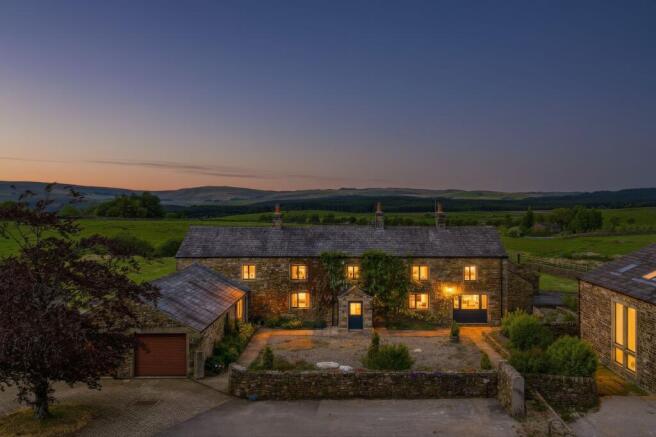
The approach to Shays Farm does its work before a word has been said. By the time you see the farmstead ahead, something has already shifted. The entrance from the road announces nothing except intention. Two stone pillars, a cattle grid, and beyond them a long private drive that sweeps through open lawns with young conifers planted in parallel lines on either side, established with the long view in mind and already beginning to lend the approach a quiet formality that will only deepen with the years. The farmstead rises in stages as the drive follows its gentle curve: slate rooflines first, then chimney stacks against the sky, then the full warmth of the Pennine sandstone as the house comes into view. The front elevation rewards the walk towards it. Three chimneys stand across a long slate roof. The dark-framed windows are placed with restraint and proportion. The stone-built garage sits to one side, its name carved into the stonework above the rolling door. And at the centre of the facade, covering much of the upper elevation and framing the porch surround completely, a wisteria of considerable age and maturity whose flowers, in season, cascade in pale white and lilac across the wall with an unhurried abundance that no designer could arrange and no amount of money can hurry. The stone-gabled porch hood gives the anthracite front door its moment without overstating it. The dry-stone boundary wall in front is perfectly at peace with the landscape behind it.
From the rear, the character of the house opens up. The original farmhouse stone rises solidly above a lower extension that brings the study and living spaces close to the garden, its Velux rooflights drawing the Pennine sky directly into the interior. To the left, the annexe reveals its own contemporary presence: full-height glazing set within the stone fabric, making no attempt to imitate what surrounds it and all the stronger for that honesty. The rear lawn sweeps in a long, striped arc away from the house, held by dry-stone walling at its upper edges before giving way to the open land beyond. The sense is one of completeness: a farmstead carefully added to, over time, by people who understood what they were working with.
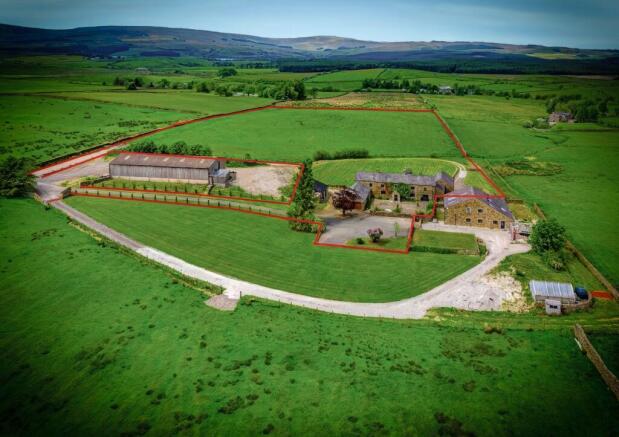
The aerial view says everything the ground-level view cannot. Shays Farm sits within its land with the settled self-sufficiency of a place that has no need of context beyond itself. The drive, the enclosed yard, the outbuildings, the lawns, the fields, the walls, and on the horizon, barely visible but unmistakably present, the peaks of the Yorkshire Dales. The Forest of Bowland rises on the hillside behind. Somewhere in the foreground field, a lamb rests against a stone wall, apparently unconcerned. It is the kind of view that takes an hour to photograph and still defies capture.
The Porch, The Snug & The Way In
The front porch, set beneath its own pitched slate roof with solid inner and outer doors, does what a proper entrance should: it creates a pause between outside and in. The snug beyond, at 11’5 x 11’1, continues in the same unhurried register. Exposed ceiling beams run overhead, their age apparent in every surface. A wood-burning stove sits within a simple oak-beam mantel on a cut stone hearth, the kind of arrangement that has no interest in being decorative, and is precisely right because of it. Fitted carpet underfoot, a wall recess to one side, the proportions of a room that knows exactly what it is. There are houses where the first room sets a tone the rest of the building then has to maintain. At Shays Farm, the snug simply makes a quiet promise that the rooms beyond keep.
The Kitchen
The kitchen itself, at 21’6 x 20’0, is the room that earns everything. White cabinetry throughout, granite worktops, a generous central island. But the eye goes immediately to the range. Sitting within a handsome stone canopy and flanked on either side by the cabinetry, the Vulcano solid-fuel range is as much a piece of craft as it is a cooking appliance: cast iron and chrome, a presence that immediately explains why the room has been arranged around it. Along the opposite wall sits a Rangemaster Professional+, providing additional cooking capacity for those occasions when the house is working at its full extraordinary scale. Between the two, this kitchen can feed anyone.
The Dining & Living Room
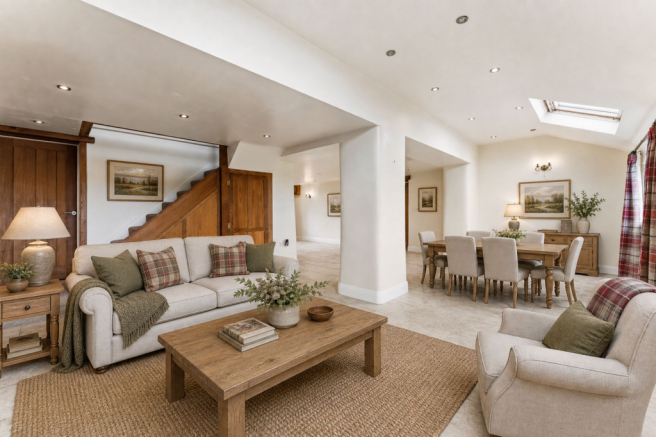
The dining and living room at Shays Farm changes your sense of what a room of this name should be. By the time you have walked the length of it, you are thinking about it differently. At 30’4 x 24’10, the room earns every inch. Two Velux rooflights bring the Pennine sky directly overhead, filling the space with a quality of diffused light that shifts through the day. The windows on both the front and rear walls deliver open countryside on each aspect: dry-stone walls, green fields, and the moorland rising to the fell. This is not a room where the view is a feature. It is a room where the view is a constant, unavoidable presence, felt from every point within it. The large-format stone floor tiles run throughout, connecting this space to the kitchen and the rest of the ground floor in a single material thread. Structural columns divide the room into sections without closing it down, lending it an organised breadth that makes the space feel purposeful rather than simply large. A built-in oak bookcase sits flush against one wall. At the staircase end, the oak stair rises with its underside panelled in warm boarding, a composed connection between this ground floor and the bedrooms above. It is a room that could hold a dinner table for twelve, two sofas, a piano and a children’s corner simultaneously and still feel generously proportioned. At this altitude, with this view, that is a considerable thing to be able to offer.
The Sitting Room & The Study
At 20’10 x 13’8, this is a room of proper scale and proper character. Substantial exposed oak beams cross the ceiling in the way only original timbers can, their age written into every surface. The carved stone fireplace surround is a piece of genuine craft: an arched stone mantel framing a multi-fuel stove on a cut stone hearth, settled against the wall with the authority of something that has never considered being moved. The window gives onto open countryside, the fields and the fell beyond. And through the doorway at the far end, the study draws the eye further still, its twin Velux rooflights filling the ceiling with sky and its French doors opening directly onto the stone terrace and the open land beyond. It is one of those axial views through a house that tells you the building understands how to connect itself to its landscape.
The study at 15’1 x 8’3 has a single well-executed idea: two large paired Velux rooflights overhead, and French doors straight ahead opening to the terrace and the fell. Stone tiles underfoot, deep stone window reveals, the same material honesty as every other room in the house. Whether used as a home office, a reading room or simply a quieter way of being near the garden, it resolves its purpose completely.
The Boot Room, The Utility & Downstairs Shower Room
The sequence begins before you reach the kitchen. The rear door, solid oak with a glazed upper half that looks back onto the stone courtyard and the wisteria-clad wall beyond, opens into a boot room that understands its purpose from the first glance. A bespoke fitted unit of warm oak holds hooks above, a bench at sitting height and closed storage below, occupying its own recess in the thick stone wall. It is exactly what a working farmhouse at this altitude demands, and it has been built with enough permanence to last as long as the building around it. The same large- format stone floor tiles run throughout, connecting boot room, utility and kitchen in a single material thread. The utility room, long and narrow under a vaulted ceiling with exposed oak beams, handles the practical work of a house this size without ceremony: white units, dark worktops, plumbing for washing appliances, a window to the yard. It is the working engine a property of this scale needs, and its direct connection through to the kitchen keeps the daily life of the house neatly ordered. Accessed from the utility, a fully tiled shower room serves the ground floor with the same practical intelligence: large-format concrete-effect tiles throughout, a vanity unit with integrated basin and WC, mirror cabinet, and a glass-screened shower enclosure. A window looks onto the stone courtyard. Both rooms sit adjacent to the garage, and taken together, this wing of the house carries genuine potential for conversion into a self-contained annexe or additional living space. For a house that works as hard as this one does, having a complete shower room on the ground floor is not an afterthought. It is exactly right.
The Principal Suite
The principal bedroom at Shays Farm occupies a position the house has earned. The views from its windows, and the quality of the space around them, make a good morning feel like a reasonable expectation. At 20’4 x 14’3, the room commands its scale with the ease of a building that has always known what its upper floor was for. Wall uplighters draw the eye upwards through the room’s full height, recessed spotlights supplementing them from above. Two windows, side by side on the fell-facing wall, frame a panorama of open fields, dry-stone walls and Pennine moorland: a view that belongs to this altitude, this landscape, and this particular address, and does not require a description so much as an early morning.
The walk-in dressing room, accessed directly from the bedroom, is fitted throughout with a bespoke oak wardrobe system of genuine quality: hanging rails across the full width, deep solid oak drawers running the length of the base, and full-height mirrors on the opposing wall creating a sense of depth that the space earns rather than borrows. The oak is warm, the organisation considered. It completes the suite properly.
The en-suite provides a fully tiled shower room: large-format stone-effect tiles with a contrasting feature panel in the enclosure, glass-screened shower, vanity unit with basin, WC and chrome heated towel rail. Compact, well-resolved, and right in its purpose.
Further Bedrooms & Family Bathroom
The remaining bedrooms are characterised by detail that restoration cannot add: original exposed beams overhead, some of them darkened and heavily aged, their surface carrying centuries of history in the grain of the timber, others with a warmer, lighter quality but no less genuine in their age. The roofline gives each room a vaulted ceiling that makes every space feel more individual than its footprint alone might suggest. Each window delivers open countryside: the fell, the moorland horizon, dry-stone walls, the approach drive, a tree line against a wide sky. In a house at this altitude, those are not features. They are simply what mornings look like.
Bedroom two, at 16’1 x 12’0, is a proper guest room with its own en-suite shower room: tiled throughout, glass-screened shower, vanity and WC.
Bedrooms three and four, at 12’6 x 10’11 and 13’7 x 12’4 respectively, are well-proportioned doubles with the same beam and roofline character as every other room on this floor, both served by the family bathroom.
That bathroom, at a generous 15’0 x 10’3, offers both a full bath and a separate glass-screened shower with overhead rainfall fitting. The window beside the bath looks onto open countryside and the fell. The view from the bath at Shays Farm, over the fields and the wide Pennine sky, is one of those details that takes a moment to fully register. Vanity unit, WC and chrome heated towel rail throughout. A bathroom that earns its scale and rewards the room it serves.
The Integral Annexe
Integral to the farmhouse but entirely self-contained, the annexe at Shays Farm offers independence without remoteness. Its own entrance, its own stove, its own acre of sky. The annexe lounge, at 21’7 x 11’1, sets its own tone from the first step in. Stone-tiled underfoot at the threshold and carpeted through the main sitting area, the room announces its character immediately: a raw, rough-coursed stone stack rising to the ceiling with a contemporary cylindrical wood-burning stove, the ancient and the modern resolving themselves with the ease of a room that has always understood what it is. A window with a stone lintel looks onto open countryside. Wall lights, a connection through to the main house, and a settled sense of belonging to the farmhouse without being absorbed by it.
The kitchen, at 11’9 x 8’6, is a well-organised working space: white units, a double oven with gas hob and stainless steel extractor, and its own external access via a black-painted stable door that opens directly to the outside. Through that door, framed cleanly in the opening, is one of the finest views in the building. The open Pennine landscape extends to the horizon with nothing between the kitchen threshold and the fell. It is the kind of view that makes coming home to cook feel like a privilege.
The annexe bedroom, at 15’5 x 11’1, is a proper room with its own quiet character. The walls retain original stone protrusions at ledge height: not fitted, simply there as they have always been, a reminder that this building was not designed but grown. Fitted carpet, wall lights, and a well-appointed en- suite bathroom providing both a freestanding bath and a separate glass-screened shower, finished with a herringbone-patterned floor and large-format stone-effect tiling throughout.
The annexe has its own independent services and private external access, making it as genuinely self-contained as it presents. For extended family, for guests, or for those requiring proximity without the loss of independence, it provides exactly the right answer.
Shays Cottage
Currently linked to the farmhouse via a glazed timber corridor, Shays Cottage is a complete home in its own right. It connects when you choose and stands alone when you don’t. The link is worth describing before the cottage itself. A short, glazed passage of timber construction leads through an original arched stone opening of considerable age, with a large window on one side framing the open Pennine landscape directly ahead. The corridor makes the connection between buildings entirely adjustable: pass through and the two properties become one; close the door and the cottage functions with the independence of any property on a separate plot. Being timber construction, it could be removed entirely to achieve full separation if required. The arched stone surround it passes through is one of the quietly impressive incidental moments at Shays Farm: rough-coursed stone, an arch of genuine age, the fell in the window beyond.
The cottage living room announces itself with a scale and character distinct from anywhere else in the building. At 22’1 x 21’1, it is a room of real breadth and genuine architectural ambition. Contemporary full-height black-framed glazing runs the full width of the end wall, drawing light and landscape through the room with a generosity that connects interior to countryside without dissolving the distinction between them. A Morso free-standing stove sits on its own slate base, its slender flue rising cleanly to the ceiling, giving the room an openness and flexibility that a conventional chimney breast could not. The staircase rises at one end, its underside fitted with oak-panelled doors and iron hardware; recessed spotlights and wall sconces light the space throughout; carpet runs the full floor. At 22’1 x 21’1 of clear, entirely flexible space, the architecture is indifferent to its label. It could serve as a cinema room, a home gym with bathroom facilities immediately adjacent, a dedicated work suite at altitude with a view no office building could provide, a private entertainment complex, a guest wing with complete independence, or a family living room of exceptional scale. Very likely, over the years, it will be several of these in turn.
The kitchen-diner, at 22’1 x 12’1, is a properly proportioned room: white handleless units with dark worktops, a double oven with stainless steel extractor, stone-tiled floor, and windows looking onto open countryside. A peninsula unit with a warm wooden top divides the cooking and dining areas without closing either down, giving the room a layout that makes feeding a large group as straightforward as a quiet meal for two.
Three bedrooms serve the upper floor, each with fell or countryside views. The principal bedroom, at 16’11 x 11’0, is fitted with a bespoke wardrobe of genuine craft: painted cabinetry with brass hardware, sections of hanging, drawer and mirror, fitted precisely to the roofline. Its en-suite provides a walk- in shower room with a Velux rooflight overhead, fully tiled throughout. The two further bedrooms, at 14’11 x 10’11 and 10’10 x 8’10, are well-proportioned doubles, each with its own view of the open countryside. The cottage family bathroom completes the floor: panelled bath, vanity, WC and fully tiled walls.
The Outbuildings & Grounds
The stone-built double garage fronting the approach driveway announces itself with the confidence of a building that takes its own quality seriously. Shays is cut into the stonework above the twin electric roller doors, which is the only identification it needs. Slate roof, warm sandstone walls, room for two vehicles with space to move freely around them, and the natural accumulation of rural life beyond. A building that belongs here. Its scale and construction also lend it potential beyond vehicle storage, whether as further annexe accommodation or additional living space, should the need arise.
The front driveway delivers into a generous forecourt with ample parking and turning space, wide enough to accommodate horse boxes as comfortably as family cars, without compromise or negotiation. The gravel front garden laid against the dry-stone boundary wall carries alpine and sedum planting across the stone coping: seasonal, low-maintenance, requiring nothing and offering something at every point of the year. Against the facade above, the wisteria has long since become part of the building’s fabric rather than a plant growing on it, its pale flowers in season cascading across the stone with the unhurried abundance of something that has stopped needing to prove itself.
The private driveway continues its sweep around the building to the rear, where a substantial covered carport provides open-fronted, solid-roofed shelter for further vehicles directly accessible from the back approach. The outbuilding complex alongside provides everything else: a substantial timber-framed store with concrete floor and secure steel containers for long-term storage; a dedicated log store currently well-stocked with split timber, positioned where the view from the kitchen window lands on it on a winter morning with entirely the right effect; and a service room housing the borehole infrastructure that provides the property with its own independent private water supply. These spaces handle the working life of the farmstead with the same thoroughness as everything within it.
The rear courtyard, enclosed within its dry-stone walls, is a different kind of outdoor space from the sweep of the front. Sheltered, contained, planted in the niches and recesses of the old wall fabric with hostas and trailing climbers. Stone steps cut directly into the corner of the wall connect the levels with the ease of something that has been navigated for generations, worn smooth by the number of times they have been used and the number of seasons they have stood here. External lighting throughout. A private space that settles the day.
The Land & The Landscape That Holds It
The 5.37 acres included in the sale are Pennine pasture of the proper kind: fields enclosed in the centuries-old geometry of dry-stone walling, suited to equestrian use, to livestock, to a smallholding at whatever scale ambition or appetite demands, or simply to the ownership of a horizon that belongs to nobody else. From the boundary, public footpaths access the open moorland and fell directly. The private approach to the farmstead alone, long and generously maintained, will accept a horse box without difficulty or compromise.
But the land at Shays Farm is not only what lies within the boundary. It is what the boundary opens onto. This is a landscape that takes some getting used to. Not because it is dramatic in the manner of Lakeland, all spectacle and compression and vertical ambition, but because it asks something quieter of the people who live within it. It is a landscape of space rather than scale. Of light rather than height. The fells rise on every compass bearing without ever closing down the sky, so the effect is of a cupped landscape rather than an exposed one: held rather than open, surrounded but never enclosed.
Shays Farm sits within this cradling as though placed there with full knowledge of what it would become. The stone of the farmstead, the walls running between the fields, the dry-stone boundaries that divide the wider landscape into its ancient patchwork: all have been worked upon by the same centuries of Pennine weather, and the result is a continuity of material and character that no new building can acquire and no amount of restoration can manufacture. The farm and the landscape have been making each other for too long to be separable.
Sunrise arrives from the east across open moorland, the light catching the limestone and heather in a colour that shifts with every season and never repeats exactly. By mid-morning, kestrels and harriers are at work above the rough ground at the field margins, hovering with the concentrated patience of creatures that understand precisely where they are. In the afternoon, from somewhere on the fell you can never quite locate, the curlews begin: the sound of the northern uplands at its most irreducible, bubbling and wild and ancient, rising and falling above the pasture. On the upper ground above the tree line, at certain times of year, deer come down to the lower fields and stand in the early light with the unconcerned authority of animals that have been here considerably longer than any of the buildings. And in the pastures that have been grazed since before the farmhouse had a roof, the sheep continue their unhurried consideration of the newcomers, as they always have.
The evenings here are a case apart. The high fells hold their last colour long after the lower ground has darkened, so the final light arrives almost horizontally across the land and catches the stone of the farmstead in a way that only the people who live here see, because by then everyone else has gone inside. The world goes very quiet at this altitude. The stoves come on. The windows glow. The smoke from the chimneys rises into a sky that is, at this hour, absolutely enormous and absolutely still.
There are places that people describe for the rest of their lives. Shays Farm is one of them.
Where Lancashire Ends & Yorkshire Begins
England’s borders between its great historic counties are not merely administrative lines. They are cultural fault lines, places where accents shift, where loyalties ran deep and sometimes bloodily, where the landscape itself seems to change character on one side of a wall from the other. The Lancashire and Yorkshire border is the most storied of all of them. For centuries this was the frontier between the Red Rose and the White, the territorial limit of two of England’s most distinct and most stubborn regional identities, the line along which some of the most consequential disputes in the nation’s history were conducted. Tosside sits directly upon it.
Bowland, Slaidburn And The Dales
The Forest of Bowland is the immediate western context, and it rewards its own description. It is one of England’s least visited and most quietly magnificent landscapes: an Area of Outstanding Natural Beauty of heather moorland, ancient grouse moors, deep gill valleys and a quality of silence that takes about an hour to stop feeling peculiar and about a week to stop being able to live without. The Trough of Bowland cuts through it, a pass of ancient use that drivers still slow down for involuntarily when the full view opens ahead of them. The valleys of the Hodder, Whitendale and Brennand are names that mean nothing to most people in England and everything to those who know them. From the fields around Shays Farm, the Bowland fells are not a destination to drive to. They are the view from the window and the walk from the front gate, the public footpaths leaving the property boundary directly for the open fell above.
Slaidburn lies three miles to the south, and it deserves every word that has ever been written about it. The village sits in the Hodder Valley with the ease of somewhere that settled on its own character a very long time ago and has not been moved from it since. A Norman church. A village green. The Hark to Bounty, a pub whose name is taken from a hunting cry as old as the forest it sits within, whose fire has been lit on enough winter evenings to have earned the room it occupies. The Hodder runs through the valley below, one of the finest salmon and trout rivers in the north of England, its water cold and clear from the fells above. The community life, the agricultural calendar, the particular quality of a village that is not a tourist attraction but simply a place where people have always wanted to be: these things are present here in a way that even the most careful preservation elsewhere rarely achieves. People go to Slaidburn to remember what an English village was supposed to feel like. They tend to return.
To the east, the Yorkshire Dales begin almost without announcement. The Three Peaks are visible on clear days from the surrounding high ground: Pen-y-ghent, Ingleborough, Whernside, rising from the Ribblesdale floor like the same thought expressed three different ways. Settle is fifteen minutes away, a proper market town on the celebrated Settle to Carlisle railway line, its restored Victorian station standing against the limestone scars with the quiet authority of a building that has always known it was in the right place. Skipton, the natural gateway to the Dales and one of the north’s finest market towns, is within half an hour, its Norman castle, its canal basin and its busy market drawing people from across the region for reasons that have not changed in centuries. Clitheroe to the south-west offers the daily requirements of a confident, independent market town, its castle keeping watch over a community that takes considerable and justified pride in what it is.
EPC Rating: C
Disclaimer
Every care has been taken with the preparation of these property details but they are for general guidance only and complete accuracy cannot be guaranteed. If there is any point, which is of particular importance professional verification should be sought. These property details do not constitute a contract or part of a contract. We are not qualified to verify tenure of property. Prospective purchasers should seek to obtain verification of tenure from their solicitor. The mention of any appliances, fixtures or fittings does not imply they are in working order. Photographs are reproduced for general information and it cannot be inferred that any item shown is included in the sale. All dimensions are approximate.
- COUNCIL TAXA payment made to your local authority in order to pay for local services like schools, libraries, and refuse collection. The amount you pay depends on the value of the property.Read more about council Tax in our glossary page.
- Band: F
- PARKINGDetails of how and where vehicles can be parked, and any associated costs.Read more about parking in our glossary page.
- Yes
- GARDENA property has access to an outdoor space, which could be private or shared.
- Yes
- ACCESSIBILITYHow a property has been adapted to meet the needs of vulnerable or disabled individuals.Read more about accessibility in our glossary page.
- Ask agent
Energy performance certificate - ask agent
Tosside, Skipton, BD23
Add an important place to see how long it'd take to get there from our property listings.
__mins driving to your place
Affordability

Get an instant, personalised result:
- Show sellers you’re serious
- Secure viewings faster with agents
- No impact on your credit score
Notes
Staying secure when looking for property
Ensure you're up to date with our latest advice on how to avoid fraud or scams when looking for property online.
Visit our security centre to find out moreDisclaimer - Property reference 1bbaebc5-6436-4e42-9b05-03fddcf16523. The information displayed about this property comprises a property advertisement. Rightmove.co.uk makes no warranty as to the accuracy or completeness of the advertisement or any linked or associated information, and Rightmove has no control over the content. This property advertisement does not constitute property particulars. The information is provided and maintained by House & Heritage, Lancashire. Please contact the selling agent or developer directly to obtain any information which may be available under the terms of The Energy Performance of Buildings (Certificates and Inspections) (England and Wales) Regulations 2007 or the Home Report if in relation to a residential property in Scotland.
*This is the average speed from the provider with the fastest broadband package available at this postcode. The average speed displayed is based on the download speeds of at least 50% of customers at peak time (8pm to 10pm). Fibre/cable services at the postcode are subject to availability and may differ between properties within a postcode. Speeds can be affected by a range of technical and environmental factors. The speed at the property may be lower than that listed above. You can check the estimated speed and confirm availability to a property prior to purchasing on the broadband provider's website. Providers may increase charges. The information is provided and maintained by Decision Technologies Limited. **This is indicative only and based on a 2-person household with multiple devices and simultaneous usage. Broadband performance is affected by multiple factors including number of occupants and devices, simultaneous usage, router range etc. For more information speak to your broadband provider.
Map data ©OpenStreetMap contributors.