
Barton Road, Worsley, M28

- PROPERTY TYPE
Detached
- BEDROOMS
5
- BATHROOMS
2
- SIZE
3,122 sq ft
290 sq m
- TENUREDescribes how you own a property. There are different types of tenure - freehold, leasehold, and commonhold.Read more about tenure in our glossary page.
Freehold
Key features
- Grade II Listed detached Georgian residence within the Worsley Village Conservation Area
- Overlooking the Bridgewater Canal - England’s first navigable waterway, constructed 1761
- Five double bedrooms and three principal reception rooms extending to over 3,100 sq ft
- Drawing room of exceptional scale at nearly 19 x 21ft with original cornicing and shutters
- Substantial country kitchen with four-oven AGA, granite worktops and original stone flags
- Principal bathroom with freestanding black cast-iron roll-top bath on original pine boards
- Walled and terraced gardens wrapping two elevations with open canal views
- Gated approach with electric gates, generous cobbled driveway and mature screening
- Vaulted cellars retaining original stone structure with scope for future development
- Walking distance of Worsley village, canal towpath and RHS Garden Bridgewater
Description
Rock House
A Grade II Listed Georgian house of exceptional standing, set within the Worsley Village Conservation Area and overlooking the Bridgewater Canal
Rock House occupies one of the most quietly commanding positions in the North West - a Grade II Listed Georgian residence standing at the very edge of the Bridgewater Canal, deep within the Worsley Village Conservation Area. The house began life as an eighteenth-century farmhouse before its transformation in the early 1800s into the composed and handsomely proportioned home seen today. It later served as the residence and working base of a senior officer of the Bridgewater Estate, a man at the centre of Worsley’s remarkable industrial story - the coal mines, the navigations, the canal that carried the wealth of the region to Manchester and beyond. That history has settled quietly into the fabric of the place. Rock House carries it without announcement.
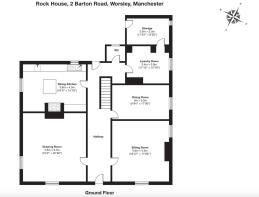
Extending to just over 3,100 square feet across three floors, the house offers five bedrooms, three principal reception rooms, a substantial kitchen, vaulted cellars and gardens that wrap around two elevations with open views across the water. It is a rare thing: a house of genuine architectural distinction, with the kind of setting that simply cannot be replicated.
The Approach
Electric gates, a generous cobbled drive and the deep shelter of established trees
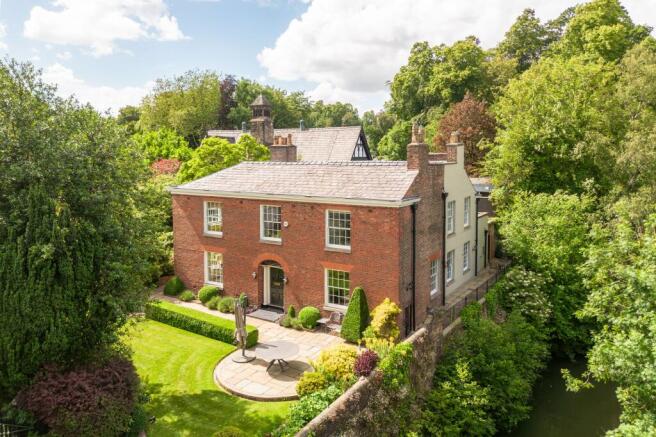
The entrance to Rock House is set behind brick piers and ornamental ironwork gates, flanked by mature screening that entirely conceals the house from the road. A broad cobbled driveway opens beyond, winding through established trees toward the house the whole sequence unhurried, private, and quietly assured. The house reveals itself gradually, its warm red brick and symmetrical Georgian facade coming into view as the drive clears the canopy.
The front elevation is a study in Georgian composure: a deeply recessed arched doorway set within red brick, flanked by stone pilasters and box ball planting, with white-painted sash windows to either side.
An arrival that prepares you well for what follows.
The Entrance Hall
A wide, light-filled reception hall with an arched fanlight, cornicing and an elegant staircase beyond
The front door opens beneath a generous arched fanlight into a hall of real stature - wide, well-proportioned and running the full depth of the house toward the staircase beyond. Painted in a warm off- white with crisp cornicing, the hall has an unhurried quality that sets the tone for the accommodation throughout.
A decorative cast-iron stove stands at its centre, a period detail that adds character without theatre. Wall-mounted brass sconces light the space in the evenings, and the staircase - painted white with a turned balustrade - rises elegantly at the far end.
A hall that arrives before the house does - calm, considered, and properly Georgian in its proportions.
The Drawing Room
A room of exceptional scale, with a period style chimneypiece, deep cornicing and a plaster ceiling rose of genuine quality
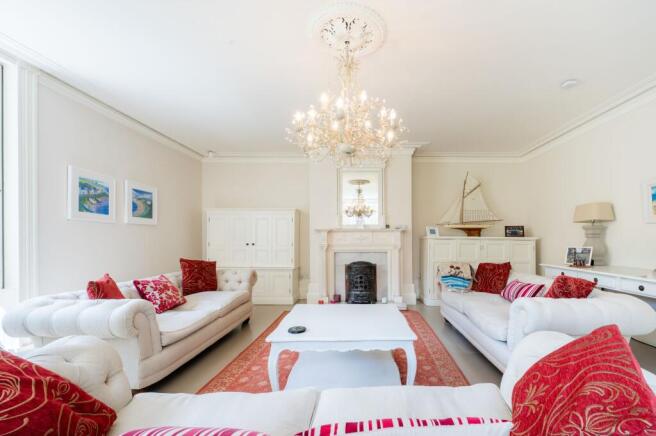
At nearly nineteen by twenty-one feet, the drawing room is the grandest space in the house - and it carries that scale with complete ease. Painted throughout in warm cream, the room is framed by deep, classically detailed cornicing and centred on an elaborate plaster rose from which a glazed chandelier descends. The chimneypiece is painted in keeping with the room, surmounted by a generous overmantel. Tall sash windows to the front and side draw light from both aspects, the original timber shutters folded back to the reveals. The floor is painted timber - pale, smooth, and consistent with the room’s composed restraint.
Space, light, and period detail in precisely the right proportions.
The Sitting Room
A dual-aspect room with original pine floorboards, a cast-iron stove and an outlook over the canal
Where the drawing room is formal, the sitting room is warmly lived-in - a room that faces the canal on one side and the garden on the other, with tall sash windows on both aspects flooding it with natural light. The original wide-board pine floor runs throughout, its warm honey tones setting the room apart from its neighbour. A cast-iron stove sits elegantly at the room’s heart, and the deep cornice and plaster ceiling rose confirm the same architectural quality found throughout the ground floor. At just under nineteen by seventeen feet, it is a generous room that wears its proportions lightly.
The canal visible through original sash glazing - a view that has defined this room for two centuries.
The Dining Room
A richly coloured, candlelit room for serious entertaining, with broad pine boards and wall sconces
The dining room occupies the quieter eastern corner of the ground floor - a room that knows its purpose and delivers it with confidence. Deep terracotta walls, orig- inal wide pine boards, and a series of brass wall sconces create an atmosphere that is genuinely suited to a long evening at the table. The room extends to just under ten by seventeen feet - substantial enough for ten or twelve with ease. A tall sash window looks out onto the canal terrace, and the corniced ceiling and paneled door architraves speak to the same period care found throughout.
A room that comes into its own after dark - warm, enclosed and properly atmospheric.
The Kitchen
A substantial country kitchen with a cream AGA, hand-painted cabinetry, granite worktops and original stone flags
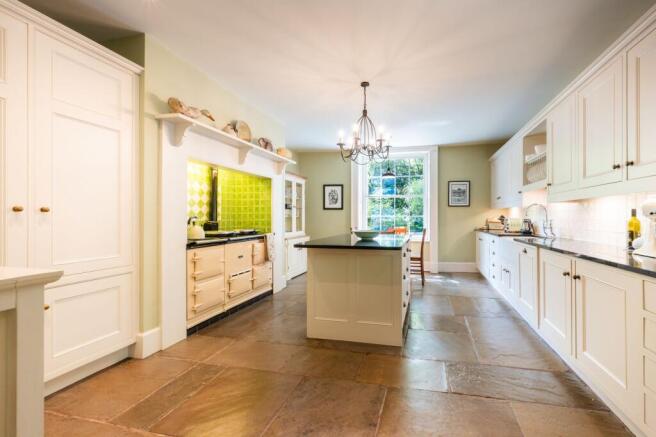
The kitchen at Rock House is a genuinely fine room - nearly nineteen by fifteen feet, with the kind of easy, well-organised layout that rewards daily life as much as serious cooking. Hand-painted in-frame cabinetry runs the full length of one wall, topped with deep granite worktops and complemented by a central island with matching granite and generous drawer storage beneath. The original chimney breast has been opened to receive a cream four-oven AGA, set against a vivid geometric tiled splashback in apple green - an unexpected detail that gives the room real personality. Underfoot, large- format stone flags run throughout, worn smooth and full of quiet warmth.
The breakfast area sits at the garden end of the room, where a tall sash window frames a view directly into the greenery beyond, drawing in the afternoon light. Integrated appliances include a NEFF dishwasher and microwave, with a Belfast sink set into the run of worktops. A door from the kitchen connects directly to the rear hall, laundry room and storeroom, keeping the practical business of the house well out of sight.
A kitchen that works as hard as it looks good - stone-flagged, AGA-warmed and thoroughly at home in a house of this age.
The Shower Room, Cloakrooms & Cellars
Practical, well-finished and, in the case of the cloakrooms, delivered with considerable conviction
The first-floor shower room provides a practical counterpart to the drama of the main bathroom - fully tiled in warm stone throughout, with a generous glazed rainfall enclosure and pedestal basin.
The ground-floor cloakroom is painted in a deep, almost lacquer-like navy from floor to ceiling - a decisive finish that gives a utilitarian space unexpected character, with a window looking directly onto the bamboo and fern planting of the rear courtyard. The first-floor WC is finished with real conviction: deep claret walls, dark-painted joinery, a pedestal basin with cross-head chrome fittings and a tall sash window looking into the tree canopy.
The Cellars
Vaulted, atmospheric and extending beneath the full width of the house
Beneath the main house, a network of vaulted cellars descends to a lower ground floor of considerable extent. The original stone structure remains entirely intact, with the characteristic arched construction of the period. The cellars offer substantial storage across several interconnecting chambers and carry an atmospheric quality that speaks directly to the age of the house. Subject to the usual consents applicable to a Grade II Listed building within a Conservation Area, they offer genuine scope for future development.
Two centuries of history beneath your feet.
The Staircase and Landing
A sweeping staircase with a mahogany handrail, painted balusters and a first-floor landing of unexpected generosity
The staircase is one of the quiet pleasures of Rock House - a broad, well-proportioned flight rising from the entrance hall with a continuous mahogany handrail curving to meet the first-floor landing above. Looking down from the top, the hall below frames the fanlit front door perfectly. The landing itself is a substantial space in its own right, with wide original pine boards underfoot, a pendant lantern overhead, and a full-height bank of painted in-frame cabinetry providing considerable storage with- out interrupting the flow of the floor. A sash window at the far end brings in natural light and a glimpse of the treetops beyond.
A landing that functions as a room - and looks the part.
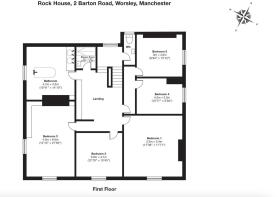
The Principal Bedroom
A room of quiet grandeur - walls that shift with the light, a painted chimneypiece, painted timber floors and a crystal chandelier
The principal bedroom occupies the canal-facing corner of the first floor and is among the finest rooms in the house. At just under eighteen
feet square, it has the proportions to carry a chimneypiece with a substantial overmantel, deep cornice mouldings, and a pendant chandelier without any sense of crowding. The walls are painted in Pavilion Blue - one of those colours that refuses to be fixed, shifting from cool grey to soft aquamarine as the light moves through the day. The floors are white-painted timber, and the overall effect is one of composed, unhurried calm. A tall sash window looks out through the tree canopy toward the canal, bringing in a quality of light that only adds to the room’s quiet restlessness.
A bedroom that earns the word principal.
The Bathroom
A room that stops you in your tracks - a black cast-iron roll-top bath, wide pine boards and a crystal chandelier
The main bathroom at Rock House is, without question, one of its defining spaces. At over fifteen by fourteen feet, it is a room of serious scale - and it is used to magnificent effect. A black cast-iron roll-top bath on claw feet stands at its centre, entirely freestanding on original wide-board pine floors that have been stripped and waxed to a warm honey tone. A tall sash window with plantation shutters draws in the light, and a crystal chandelier hangs above. The overall atmosphere is somewhere between the theatrical and the deeply tranquil.
A bathroom that takes its time - and rewards the same.
Bedroom Two
A remarkably generous dual-aspect room with original wide pine boards, two sash windows and a cast-iron stove.
The second bedroom is, by any measure, an exceptional room - nearly fifteen by twenty-two feet, with original wide-board pine floors that glow in the afternoon sun, and two tall sash windows on different aspects flooding the space with light. A cast-iron stove with a simple painted fireplace sits at one end, and fitted cabinetry with integrated shelving runs the full width of one wall. Currently configured as a study and music room, the room has the scale and character to serve any number of purposes.
Possibly the most versatile room in the house - and certainly one of the most characterful.
Bedrooms Three, Four and Five
Three further double bedrooms, each with a sash window, period detail and a distinct character of their own
The remaining three bedrooms continue the pattern of good proportions and careful finish. One is painted in a warm soft green, another in a calm blue - both generously sized doubles with tall sash windows to the garden and village. The fifth bedroom is a well-proportioned room in pale tones with a sash window - well suited as a guest room. Each room has the architectural DNA of the house: original mouldings, deep skirting and sash glazing throughout.
The Gardens
Mature, exceptionally planted and overlooking one of England’s most historically significant waterways.
The gardens at Rock House are, in every sense, as remarkable as the house itself. Wrapping around two principal elevations and descending in terraced layers toward the Bridgewater Canal, they have been planted and tended with a gardener’s eye and a real understanding of what this setting demands.
To the front, a flagged terrace in aged sandstone runs the full width of the house, edged with clipped box hedging, lavender and topiary. Beyond, a striped lawn opens toward the canal boundary, where iron railings give way to open views across the water toward the timber- framed buildings of historic Worsley village - a number of which carry black and white Tudor-style detailing that speaks to the area’s long instinct for preservation and presentation. The canal here widens at Worsley Delph - the famous ochre-stained waters that mark the entrance to the underground mine navigations that helped fuel the Industrial Revolution.
To the east, the garden drops to a lower canal-side terrace - a private, sheltered seating area framed by densely planted beds of ferns, euphorbias and other architectural planting, with the Bridgewater Canal stretching away in both directions. Beyond the garden boundary, a pedestrian footbridge crosses the water toward the opposite towpath and the wider village beyond. To the rear, a flagged courtyard with rendered raised planters is richly planted with bamboo, tree ferns and shade-loving species. On the western side, a gravel garden with circular feature bed and stone bench is sheltered by mature canopy and planted with Japanese maples and other considered species - a quieter, more contemplative space. The drive accommodates multiple vehicles within the gated enclosure.
A garden in complete sympathy with its setting - layered, considered and almost impossibly well positioned.
Worsley and the Bridgewater Canal
A village of national significance, at the birthplace of England’s canal system
Worsley is one of the most historically resonant villages in the North West - a place where England’s industrial story began in earnest. The Bridgewater Canal, constructed in 1761 for the 3rd Duke of Bridgewater to carry coal from his mines to Manchester, was the country’s first true man-made navigation and the catalyst for the national canal network that followed. It remains in water today, its surface a distinctive amber-orange, coloured by the iron-rich runoff from the Worsley Navigable Levels - an astonishing network of over forty miles of underground canal tunnels that honeycomb the bedrock beneath the village. The entrance to that network, Worsley Delph, lies directly opposite Rock House.
Rock House sat at the centre of all of it - literally and historically. Adjacent to the property stands the former Courthouse, one of several significant historic structures that together form one of the most intact and evocative industrial heritage streetscapes in England. The towpath outside the gates connects directly to RHS Garden Bridgewater and the wider canal network beyond.
Despite this depth of history, Worsley today is a peaceful, well-served village. Local restaurants, pubs and everyday amenities are within easy walking distance. St Mark’s C of E Primary and the independent Bridgewater School serve the area, and Manchester city centre, MediaCityUK and Salford Quays are all within fifteen to twenty minutes by car via the M60 and M62.
Somewhere very few addresses in England can offer what this one does: history you can see from the window, quiet you can depend on, and a city within easy reach.
A Note from the Owner
In his own words...
When we first viewed Rock House in 1984, it had been poorly treated for a long time - the kitchen had been converted into an internal garage, stone floors were hidden under plastic tiles, and the hall ceiling under polystyrene. But even then, it was unmistakably a substantial Georgian house, with everything that means: the form, the space, the proportions, the ceiling height, the windows. Add its position on a private plot gazing out across water to splendid views, and it was clear that, with time and effort, this could become a wonderful family home. The history of the house, its significance in the story of the Bridgewater Estate, and the fact that the bricks and the nails holding the floorboards were made locally - all of that added to the appeal.
My first move each morning is to open the bedroom blind and take in the view across the garden and along the canal to the humpback bridge in the middle of the village. Whatever the season or weather, that view is a wonderful way to start the day. As the house faces southeast, the sun rises through the tall trees across the canal and travels across the front of the house during the morning, making the sitting room and drawing room beautifully light, with window patterns on the floors. By afternoon it arrives in the west, bringing a warm glow to the kitchen. From morning to night, as you move through the house,
there are views of trees, garden and canal from every window - you feel connected to the surroundings while remaining, helped by the secondary glazing throughout, in a wonderfully calm and peaceful environment.
The sitting room is where I spend most of my time. It is dual aspect, light, quiet, and the perfect place to read or play the piano. In the evenings, if the weather is good, I sit with a glass of wine and watch the canal boats pass. The cellar has been perfect for children’s Halloween parties. My older daughter’s fortieth birthday was celebrated here on a May evening, with guests spread across the gardens and terrace and outside caterers making the most of the setting. For many years my family came to me for Christmas lunch. The house dresses beautifully for it.
Worsley Old Hall is my favourite pub, a ten-minute walk away, where I meet friends for lunch fairly regularly. Local walks are a daily routine - along the canal or through the woods just across the road. The community here is very active: coffee mornings in the library next door, events on Worsley Green in summer, and at Christmas, father christmas arrives by narrowboat along the canal to meet local children on the bank. It is that kind of place.
What I will miss most is the views - a borrowed landscape that somehow feels as though it belongs to me, and that gives a peaceful connection to the natural world. For me, Rock House is a private, peaceful sanctuary of light, space, trees and water. People rarely visit without commenting on what a lovely house it is.
- The Owner, Rock House, 2026
EPC Rating: D
Disclaimer
Every care has been taken with the preparation of these property details but they are for general guidance only and complete accuracy cannot be guaranteed. If there is any point, which is of particular importance professional verification should be sought. These property details do not constitute a contract or part of a contract. We are not qualified to verify tenure of property. Prospective purchasers should seek to obtain verification of tenure from their solicitor. The mention of any appliances, fixtures or fittings does not imply they are in working order. Photographs are reproduced for general information and it cannot be inferred that any item shown is included in the sale. All dimensions are approximate.
- COUNCIL TAXA payment made to your local authority in order to pay for local services like schools, libraries, and refuse collection. The amount you pay depends on the value of the property.Read more about council Tax in our glossary page.
- Band: G
- PARKINGDetails of how and where vehicles can be parked, and any associated costs.Read more about parking in our glossary page.
- Yes
- GARDENA property has access to an outdoor space, which could be private or shared.
- Yes
- ACCESSIBILITYHow a property has been adapted to meet the needs of vulnerable or disabled individuals.Read more about accessibility in our glossary page.
- Ask agent

Add an important place to see how long it'd take to get there from our property listings.
__mins driving to your place
Affordability

About House & Heritage, Lancashire
4a Scarisbrick House The Common, Parbold, WN8 7DA

Notes
Staying secure when looking for property
Ensure you're up to date with our latest advice on how to avoid fraud or scams when looking for property online.
Visit our security centre to find out moreDisclaimer - Property reference f4e7b075-920a-4b31-ab81-15721789b8e7. The information displayed about this property comprises a property advertisement. Rightmove.co.uk makes no warranty as to the accuracy or completeness of the advertisement or any linked or associated information, and Rightmove has no control over the content. This property advertisement does not constitute property particulars. The information is provided and maintained by House & Heritage, Lancashire. Please contact the selling agent or developer directly to obtain any information which may be available under the terms of The Energy Performance of Buildings (Certificates and Inspections) (England and Wales) Regulations 2007 or the Home Report if in relation to a residential property in Scotland.
*This is the average speed from the provider with the fastest broadband package available at this postcode. The average speed displayed is based on the download speeds of at least 50% of customers at peak time (8pm to 10pm). Fibre/cable services at the postcode are subject to availability and may differ between properties within a postcode. Speeds can be affected by a range of technical and environmental factors. The speed at the property may be lower than that listed above. You can check the estimated speed and confirm availability to a property prior to purchasing on the broadband provider's website. Providers may increase charges. The information is provided and maintained by Decision Technologies Limited. **This is indicative only and based on a 2-person household with multiple devices and simultaneous usage. Broadband performance is affected by multiple factors including number of occupants and devices, simultaneous usage, router range etc. For more information speak to your broadband provider.