Eastern Cape, Graaff-Reinet, South Africa

- PROPERTY TYPE
Farm
- BEDROOMS
5
- BATHROOMS
2
- SIZE
Ask agent
Key features
- Country Living
- Country Style
- Covered Patio
- Fireplace
- Irrigation System
- Parquet Floors
- Mountain
- Totally Fenced
- Veranda
- Wooden Floors
Description
LOCATION: ± 25 km from Graaff Reinet
SIZE: ± 4,522.5335 ha
CARRYING CAPACITY: ± 18 ha/LSU – Govt. Assessment 1990 (Total: ± 260 LSU’s)
ANNUAL RAINFALL: ± 340 mm
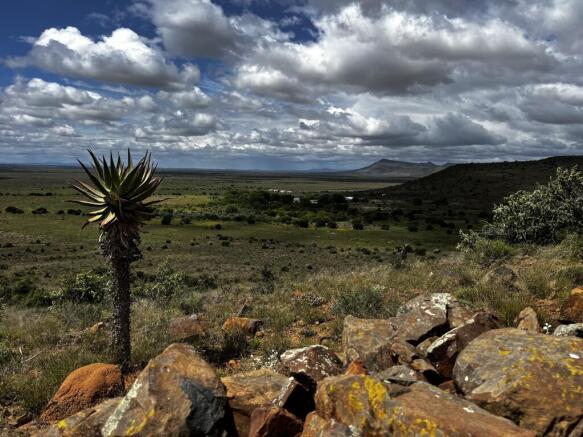
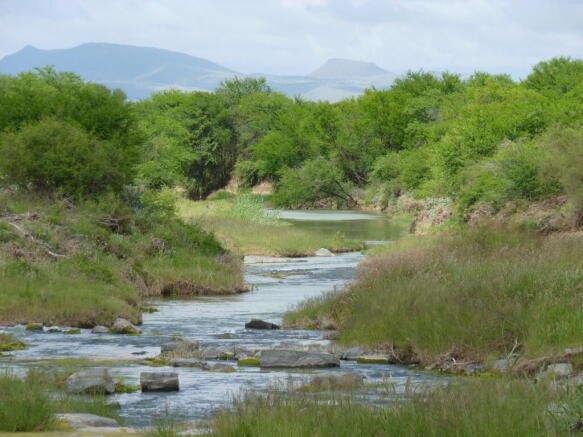
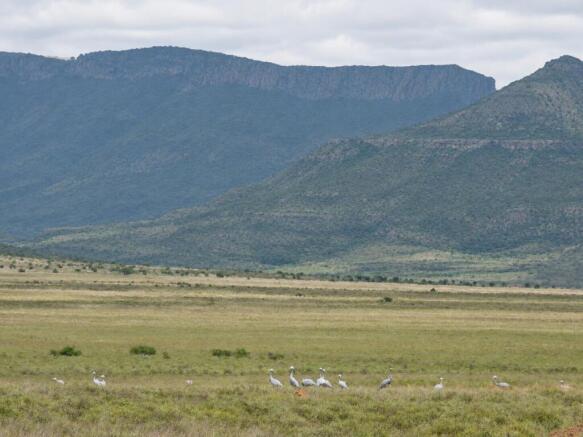
TOPOGRAPHY: In the north there are open Karoo plains at ± 680 m ASL where an easterly flowing non-perennial river falls just within the northern boundary. Southwards the plains gradually rise to ± 720 m ASL where they bordered by a low SE to NW running ridge with the highest hill reaching ± 836 m ASL beyond which is the south-western boundary. To the south-east of the ridges open plains again fall away to the banks of a south flowing non-perennial river, which flows for 4 km through the property with the lowest altitude of ± 630 m ASL to be found on the southern boundary. To the east of the river there is ± 700 ha of open Karoo plains containing a portion of irrigable land. The central hills are stony with adjoining gravels to the south while the northern and south-eastern part of the property nearer to the rivers have very deep and fertile soils.
VEGETATION: There are three distinct veld types:
River Veld – A ± 8.9 km portion of very valuable river veld with Sweet Thorn Trees (Vachellia karroo) and River Ganna (Salsola aphylla) dominating the river banks and adjoining veld respectively. Other flora includes Karee (Searsia lancea), dwarf and succulents shrubs, and Bur Bristle Grass (Setaria verticillata), Blue Buffalo Grass (Cenchrus ciliaris), Guinea Grass (Panicum maximum), Kikuyu (Cenchrus clandestinus) and Quick Grass (Cynodon dactylon) under the taller shrubs and trees and on the river banks.
Ridges & Hills – Broken Karoo veld made up of typical dwarf and succulent shrubs including Anchor Karoo Bush (Pentzia incana), and legumes with taller shrubs and trees including Spike Thorn (Maytenus heterophylla), Guarri (Euclea undulata), Jacket Plum (Pappea capensis), Karoo Shepherd’s Tree (Boscia oleoides), with some Spekboom (Portulacaria afra), and a few Bitter Aloe (Aloe ferox). Dominant grass species include Klipgras (Aristida diffusa), Spear Grass Heteropogon contortus) Quick Grass (Cynodon dactylon), Weeping love grass (Eragrostis curvula), Lehmann’s Love Grass (Eragrostis lehmanniana) and Red grass (Themeda triandra).
Open Karoo Plains - Typical of the Lower Karoo Biome with dwarf and succulent Karoo shrubs including Anchor Karoo Bush (Pentzia incana), legumes, Wilde Aster (Felicia filifolia) etc. Grasses to be found include Lehmann’s Love Grass (Eragrostis lehmanniana) interspersed with Tassle Three-awn (Aristida congesta), Quick Grass (Cynodon dactylon), and some Blue Buffalo Grass (Cenchrus ciliaris) and Guinea Grass (Panicum maximum) under the taller shrubs and trees.
FARM INFRASTRUCTURE: The farm is divided into ± 57 camps, not including 7 smaller camps near the homestead. All the fencing is in a good to very good condition with just over 9 km of the ± 40 km perimeter jackal proof netting fence having been upgraded to a ± 2.4 m high game fence on the north-eastern boundary. At the homestead there are both small stock and cattle handing facilities, and several additional sets of kraals are situated in the veld.
WATER SUPPLY: The natural fountain above the homestead is a standout feature of the property. In November 2020, after four years of drought in the region, it was still yielding 4,230 litres per hour. The farm recorded just 199 mm of rain for the whole of 2020, well below its annual average. Water from the fountain is piped to a concrete reservoir of approximately 950,000 litres at the homestead. It supplies the household, irrigation and livestock watering points, with water gravity-fed to most of the lower half of the farm. A strong borehole fitted with a submersible pump powered by eight solar panels supplies all livestock watering points in the central and northern parts of the farm. In the south-east, three boreholes fitted with submersible pumps and powered by municipal electricity supply the livestock watering points in that section, as well as the centre pivot and adjoining drip irrigation. In good seasons, the three rivers on the property provide an additional source of water. Approximately nine strong boreholes, drilled by the municipality many years ago, are scattered across the northern plains and are currently unused. Of the farm’s approximately 64 camps, all but one are supplied with water from the fountain or boreholes. The remaining camp relies on river water. No windmills are currently in use.
IRRIGATION: Approximately 10 ha were until recently irrigated. This included ±2 ha near the homestead under drip and drag-line irrigation, a 5 ha centre pivot used for lucerne production, and an adjoining 3 ha under drip irrigation used for onion seed production. The irrigation is currently not utilised. A further ±15 ha were historically developed for irrigation near the homestead. The fountain water supplied to the reservoir is sufficient to redevelop part of this area. Deep soils and strong boreholes in the northern part of the farm offer scope for further irrigation development.
POWER SUPPLY: Municipal electricity
BUILDINGS: The ± 400 m² historic Karoo style homestead has 5 bedrooms, 2 bathrooms, office, lounge, dining room, and kitchen and contains many attractive Victorian features and fittings with Oregon pine floors, ceilings, and sash windows while the older part of the house has yellowwood floors. The north-facing veranda has an adjacent lawn and garden with a 24 m x 8 m swimming pool and the homestead is surrounded by large mature shade trees. Close by are situated numerous outbuildings including an ± 850 m² shearing shed with a new galvanised iron roof, workshop, storerooms, garages, meat-room, and adjoining walk-in cold-room. An open-sided 120 m² lucerne shed is situated at the 5 ha centre pivot. The farm has four staff cottages supplied with electricity and water.
LIVESTOCK & GAME: Currently (November 2026) the farm is carrying ± 700 Merino ewes with ± 150 lambs, and ± 80 Angus, Bonsmara, and Tuli cows with followers. Naturally occurring game includes Kudu, Springbok, Mountain Reedbuck, Steenbok, and Duiker.
Eastern Cape, Graaff-Reinet, South Africa

Notes
This is a property advertisement provided and maintained by Hamptons, International (reference 22324803_15834523) and does not constitute property particulars. Whilst we require advertisers to act with best practice and provide accurate information, we can only publish advertisements in good faith and have not verified any claims or statements or inspected any of the properties, locations or opportunities promoted. Rightmove does not own or control and is not responsible for the properties, opportunities, website content, products or services provided or promoted by third parties and makes no warranties or representations as to the accuracy, completeness, legality, performance or suitability of any of the foregoing. We therefore accept no liability arising from any reliance made by any reader or person to whom this information is made available to. You must perform your own research and seek independent professional advice before making any decision to purchase or invest in overseas property.